
Blog
Texas Probate Equipment Appraisal: What Houston Estates Must Report by Law
A Texas probate equipment appraisal establishes the fair market value that state law requires executors to report within 90 days of qualifying. This guide walks Houston families through the inventory deadline, the affidavit-in-lieu option, and when a written appraisal protects the estate from disputes or IRS scrutiny.
When a Houston estate includes a tractor, a fleet of restaurant fryers, a dental office's equipment, or a machine shop's tooling, Texas probate law does not treat that equipment as a special category. It is personal property, and the executor has to report it on the estate's sworn inventory at its fair market value on the date of death. Missing the deadline, guessing at a number, or skipping documentation can create real problems for heirs, for the court, and for the estate's tax filings. This guide covers what the Texas Estates Code actually requires, when an affidavit can replace the filing, and what our Houston equipment appraisal team typically recommends executors gather before they sign an inventory under oath.
What Texas Probate Law Requires for Equipment in an Estate
Equipment owned by the decedent, whether it is agricultural machinery, commercial kitchen assets, or medical devices, becomes part of the probate estate the same as furniture, vehicles, or jewelry. Texas law requires the personal representative to list this property along with everything else the estate owns, and to state a fair market value for each item as of the date the person died, not the purchase price and not a tax-assessed value. General probate practice describes the inventory and appraisement as the document the court, the heirs, and (where relevant) taxing authorities rely on to confirm what the estate actually held and what it was worth, as explained in a Texas probate attorney's overview of the inventory and appraisement's role in Texas probate court filings serve.
The statute does not carve out a separate rule for machinery, vehicles, or industrial equipment. Whatever the decedent owned free and clear (or with a lien the estate still has to disclose) goes on the same form, in the same format, with the same fair market value standard applied.
The 90-Day Inventory, Appraisement, and List of Claims Deadline
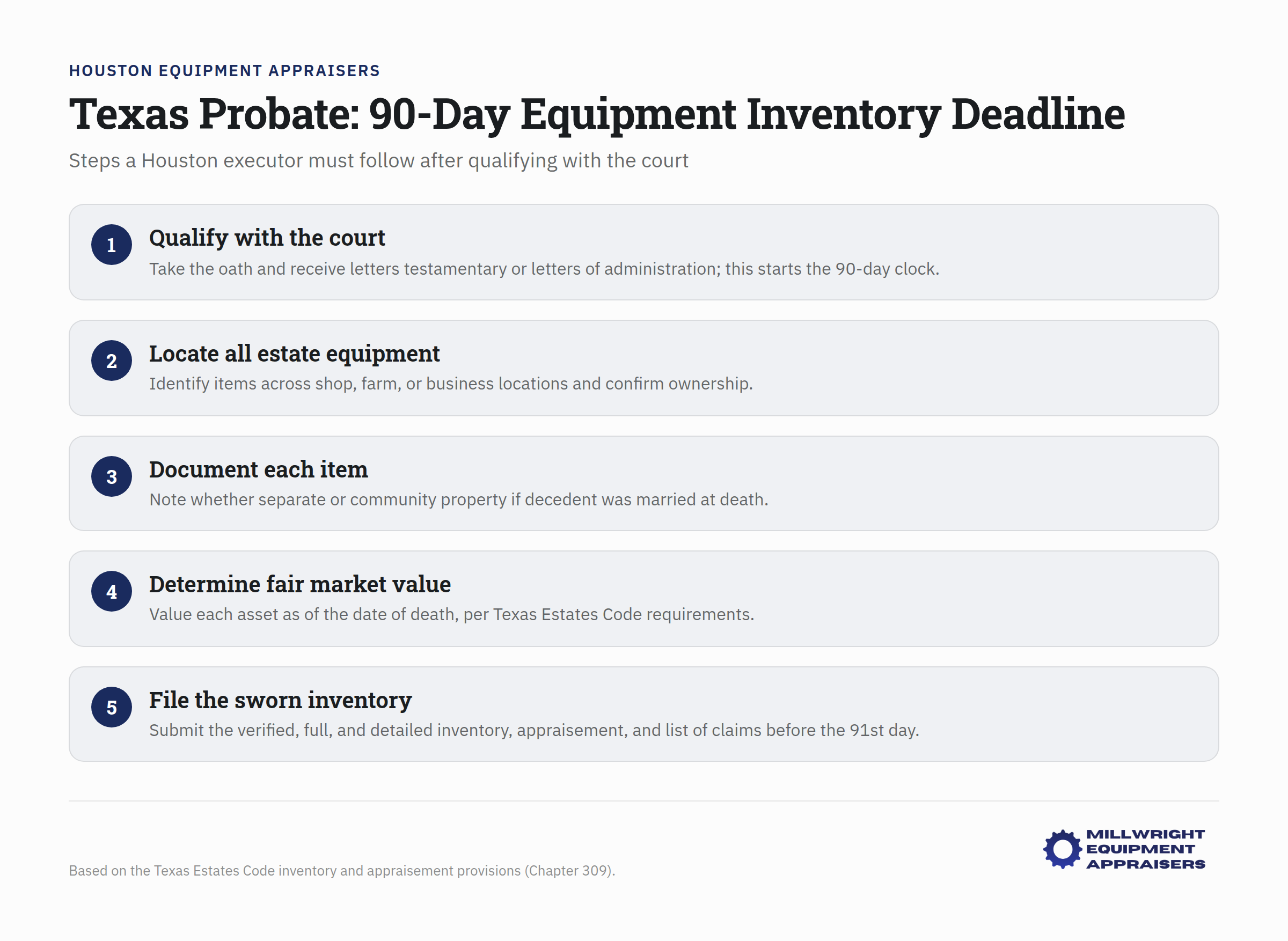
An executor or administrator in Texas has to file a verified, full, and detailed inventory, appraisement, and list of claims before the 91st day after qualifying, unless the court grants an extension. This deadline runs from the date the representative qualifies (takes the oath and receives letters testamentary or letters of administration), not from the date of death.
The requirement itself, including what property must be listed and how it must be valued, comes directly from the Texas Estates Code's inventory and appraisement provisions. The statute requires the representative to include all Texas real property and all personal property anywhere located that has come into their possession or knowledge, and to note whether each asset is separate or community property if the decedent was married at death.
For a Houston estate with equipment scattered across a shop, a farm, or a business location, this 90-day window is tight. Locating every piece of equipment, confirming ownership, and arriving at a defensible value takes real time, especially if records are incomplete or the equipment sits at a business the family is also trying to wind down.
Why Equipment Must Be Valued at Fair Market Value on the Date of Death
Fair market value on the date of death is the standard the inventory requires, and it is also the standard that matters most if the IRS ever questions the estate's federal tax return or if heirs later disagree about what an item was actually worth. A number pulled from memory, an old invoice, or a rough guess does not hold up the same way a documented valuation does. Our equipment fair market value methodology walks through how appraisers reach that figure using comparable sales, condition, age, and usage data rather than simply depreciating the original purchase price.
A probate inventory is a sworn legal document. The representative signs it under oath, and Texas courts (and, where applicable, taxing authorities) can hold the estate accountable if the values turn out to be unreasonable. One Texas probate law resource notes that courts and beneficiaries increasingly expect a level of detail in estate inventories that goes well beyond a single lump-sum guess for "equipment" or "shop tools."
Watch out: If heirs dispute the estate's equipment values later, whoever produced the number (the executor, informally) has to defend it. A written appraisal supported by comparable sales and documented condition is far easier to defend than a figure with no paper trail behind it.
Documentation Houston Executors Should Gather Before Filing
Before an executor files the sworn inventory, or before an appraiser can produce a usable valuation, the estate needs specific records for each piece of equipment. Harris County's own probate forms, including the inventory and appraisement form used by Harris County courts, require the representative to identify and describe each asset clearly enough for the court to verify it later.
Gather the following for every piece of equipment in the estate:
- Serial numbers and model information: the manufacturer's plate or stamped identification for each machine or vehicle.
- Hours or mileage: engine hours for equipment, odometer readings for vehicles, since both drive resale value.
- Maintenance and repair records: service logs, receipts, or warranty paperwork that show condition and upkeep history.
- Photographs: current images showing overall condition, visible wear, and any damage.
- Purchase records: original invoices or titles, useful for establishing ownership even though they do not establish current value.
Our equipment appraisal documentation checklist for Houston estates goes through this in more depth, including what to do when records are missing or incomplete, which happens often in estates where the decedent ran a business informally.
Affidavit in Lieu of Inventory: When Executors Can Skip the Filing
Not every independent executor has to file the full sworn inventory with the court. Texas law allows an independent executor to file an affidavit in lieu of inventory instead, provided all estate debts (other than debts secured by real estate) have been paid and there is no unpaid federal estate tax obligation. The affidavit still requires the representative to prepare a full inventory, list of claims, and appraisement, but that document goes to the estate's beneficiaries rather than the probate court, as set out in the Texas Estates Code's affidavit in lieu of inventory provision.
This matters for equipment-heavy estates because it changes who reviews the values, not whether the values have to exist. The executor still has to determine fair market value for every asset, including equipment, and still has to be ready to produce it if a beneficiary asks or if a dispute arises later.
Independent vs Dependent Administration: Does an Appraiser Have to Be Involved?
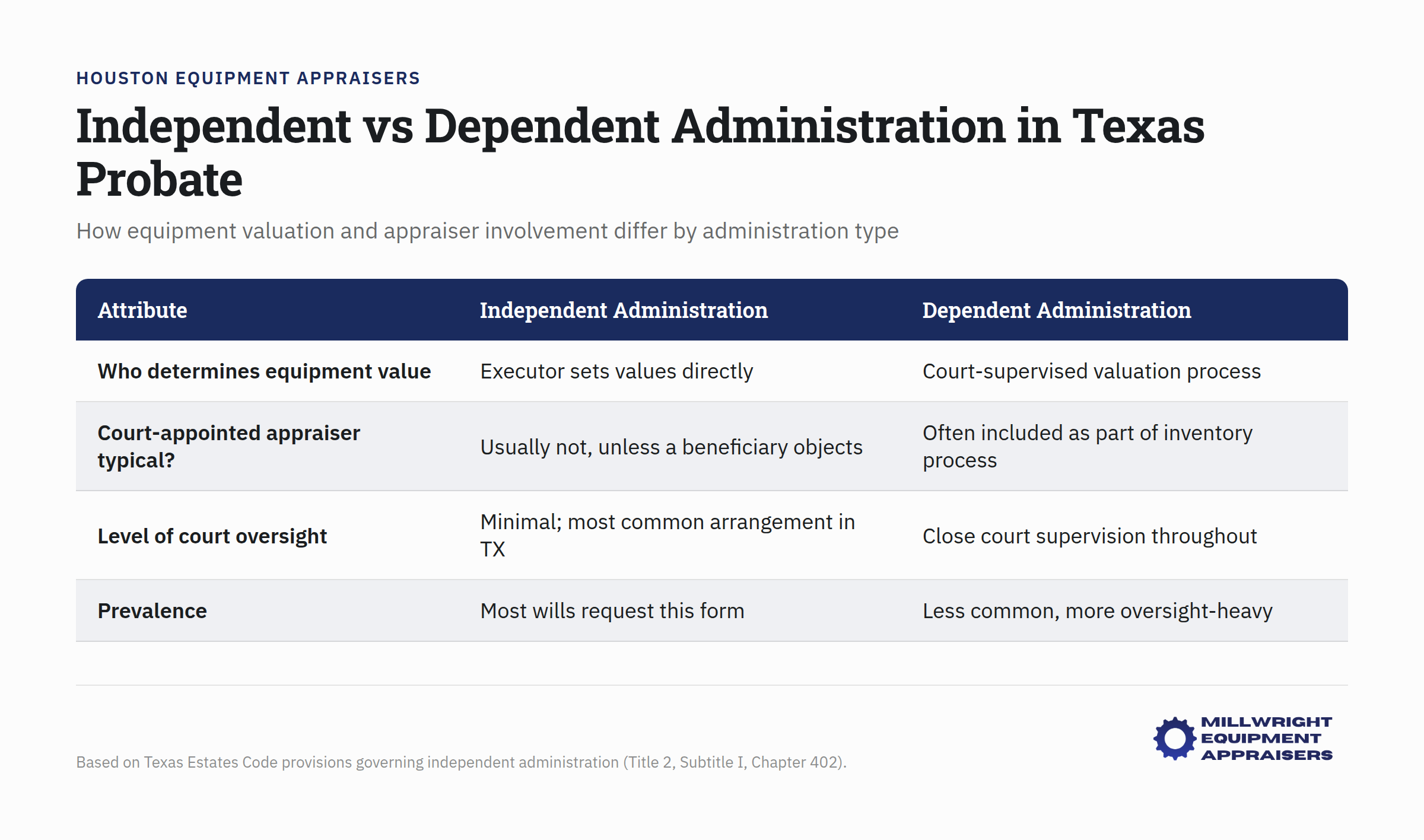
Whether a court-appointed appraiser gets involved depends heavily on whether the estate is under independent or dependent administration. Independent administration, the more common arrangement in Texas and the one most wills request, generally lets the executor determine values without court appraisers unless a beneficiary raises an objection.
Dependent administration, which involves closer court supervision throughout the process, more often includes court-appointed appraisers as part of the inventory process. The distinctions between these two forms of administration, including how much court oversight applies at each stage, are laid out in the Texas Estates Code provisions governing independent administration.
In either arrangement, using a qualified equipment appraiser is not mandated by statute for every estate. It becomes a practical necessity when the equipment is valuable, when heirs disagree, when the estate might owe federal estate tax, or when the executor simply doesn't have the market knowledge to defend a number under oath.
When to Commission a Formal Equipment Appraisal
A formal, written equipment appraisal makes the most sense in a handful of recurring situations: high-value machinery where a wrong guess creates real tax or distribution risk, disagreement among heirs about what equipment is worth, an estate large enough to face federal estate tax exposure, or a business's equipment that needs to be separated out for sale, buyout, or continued operation by one heir.
Appraisal fees for equipment and machinery engagements are quoted as a fixed fee after we scope the assignment, based on the number of assets, the complexity of the equipment, the completeness of existing records, and whether the report needs to meet IRS-qualified standards for estate tax purposes. Standard equipment appraisals typically start at $295, IRS-qualified reports start at $395, and most estate engagements fall in the $695 to $3,000 range depending on how many assets are involved and how much analysis each requires. Larger or highly specialized equipment portfolios can run higher. These are always fixed fees agreed to before work begins, never billed by the hour.
Pro tip: Commission the appraisal early in the 90-day window, not the week before the filing deadline. Locating equipment, verifying serial numbers, and researching comparable sales takes longer than most executors expect, especially for specialized machinery with a thin resale market.
Getting the inventory right the first time protects the executor personally, keeps the estate on schedule with the court, and gives heirs a documented, defensible number if anyone later questions what the equipment was actually worth.
This article is provided for general informational purposes only and does not constitute legal, tax, or financial advice. Readers should consult a qualified attorney or CPA regarding their specific circumstances.